

General application O-rings

General application O-r
General application O-r
O-rings are highly versatile and widely used as a sealing solution due to their efficiency, affordability,and ease of use in both static and dynamic applications.They are crafted from a wide range of elastomer materials,capable of sealing practically any liquid or gas.
Designing and producing O-rings requires careful consideration of several factors, including quality,quantity,application environment,cost-effectiveness,chemical and pressure compatibility,longevity and lubrication requirements.
The Versatility of O-ring Seals
O-rings are versatile seals,typically elastomeric but also available in materials such as PTFE or metal,exhibiting a bi-directional, circular design.They function by deforming their material under installation and media pressure to effectively seal gaps between mating components.
However,these seals are not impervious to issues.High system pressures can lead to a phenomenon known as extrusion,where the seal material deforms into the gap,resulting in seal failure.This issue can be mitigated by employing harder seal materials or introducing back-up rings for support.
The strength of an O-ring lies in its ability to behave like a highly viscous fluid under pressure,creating a positive barrier against the medium it's designed to seal.This unique attribute,coupled with its capacity to revert to its original shape post-deflection,makes O-rings invaluable in sealing applications.
Additionally,the O-ring's elastomeric nature allows it to adapt to unit tolerance variations,maintaining a sealed condition.The squeeze,or the degree of compression,is a crucial factor in the design of O-ring seals.For O-rings with smaller cross sections,a higher degree of squeeze is needed to counterbalance larger groove dimension tolerances.
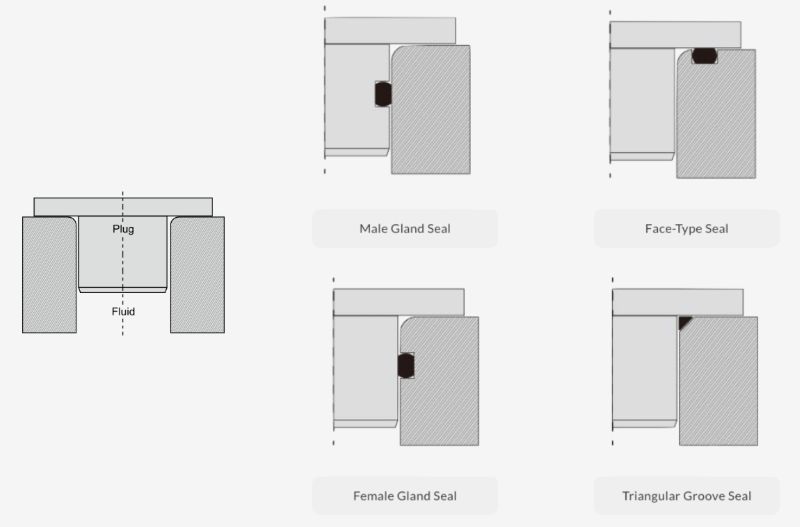
In terms of the assembly aspect,in general O-Ring can be selected in four sealing types:
A solution for every industrial application.